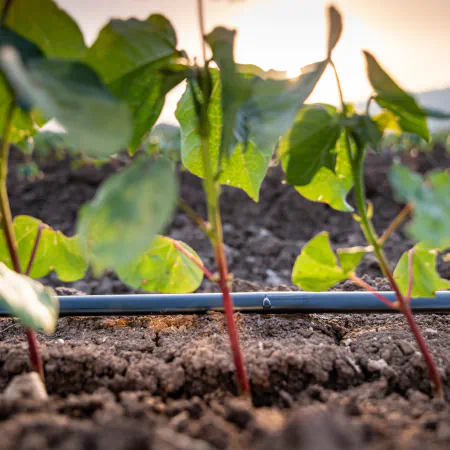
Subsurface drip irrigation is a technology with numerous benefits for water use, but there is limited evidence about its feasibility in peanut cultivation, due to potential overlaps between pod growth zones and the placement of irrigation laterals. This paper aims to evaluate the crop’s response to water supply through underground drip irrigation and the compatibility of this technology with peanut cultivation. The ASEM 400 INTA cultivar was grown on irrigated land supplied by underground drippers and on non-irrigated land. The crop’s responses, related to carbon and water efficiency, were significant with the subsurface drip irrigation system, and placing irrigation laterals at depths greater than the pod growth zone demonstrated the feasibility of using this technology.
Keywords: irrigation, subsurface drip irrigation, peanut.
Introduction
Water supplied below the surface in the root zone through the subsurface drip irrigation (SDI) system significantly reduces losses from surface runoff, evaporation, and groundwater recharge (Lamm et al., 1998), and increases water use efficiency. In peanut cultivation, this technology, in addition to the previously mentioned benefits, prevents canopy wetting and reduces humidity inside the canopy, thereby minimizing the likelihood of foliar diseases and soil fungal complexes.
The depth at which the irrigation laterals (ILs) are buried is important for this crop, because harvesting the pods involves soil removal and may damage the laterals. Therefore, this aspect is crucial during system installation, requiring a lateral depth greater than 35 cm (preferably 45 cm), which ensures that the peanut harvest will not damage them.
The objectives of this paper were to evaluate (i) the crop’s responses to water supply through SDI and (ii) the feasibility of using SDI technology in peanut cultivation.
Material and Methods
The experiment was conducted at the Manfredi Agricultural Experimental Station at the National Institute of Agricultural Technology, Córdoba, Argentina. The ASEM 400 INTA cultivar was sown on 19 December 2017 at a density of 14 plants m-² with a spacing of 0.7 m between rows of plants. The harvest took place on 18 May 2018. The experimental unit was 11 m wide and 70 m long. The soil was a silty loam Typic Haplustoll and had no limitations for root proliferation and crop growth.
The treatments included two water availabilities: irrigated and non-irrigated land. Irrigation was supplied through subsurface drippers and according to water balance methodology proposed by Severina et al. (2012). The subsurface drip irrigation equipment, provided by the company Metzerplas, was composed of irrigation laterals with a 1.4 m separation amongst them, 50 cm spacing between emitters and a flow rate of 1.2 l/h. The non-irrigated condition included only the provision of rainfall.
The soil water content was periodically measured up to 2 m deep by a neutron probe. Water consumption was determined as the difference between initial usable water and final usable water, together with rainfall and irrigation in the periods analysed.
In addition to the water measurements, the biomass was sampled, while crop-intercepted radiation and leaf temperature were measured. The biomass was partitioned in aerial and subsurface parts and was dried at 70°C up to constant weight. The intercepted radiation was determined by radiation measurements above and below the canopy using a ceptometer. Leaf and air temperature were measured using an infrared thermometer and the daily values of the level of cumulative stress were determined according to Jackson et al. (1977). The efficiency in the use of total biomass water resulted from the slope of the relationship between the total biomass corrected by energy cost and water consumption.
The efficiency in the use of grain water was determined from the quotient between grain production to harvest and total water consumption. At harvest, the yield in grains, number of grains per area unit and average grain weight were determined. The first and the third were determined at 0% humidity.
Findings and discussion
Precipitation during the crop cycle was 284 mm, significantly lower (-40%) than the historical records (series 1931-2015) (https://inta.gob.ar/documentos/informacion-meteorologica-mensual-de-la-eea-manfredi) of 465 mm, and the irrigation applied was 210 mm. Water consumption throughout the crop cycle showed two contrasting responses (Fig. 1a). The first, represented by the sowing period – 65 days after sowing (DAS) – was similar between treatments and resulted in a consumption of 250 mm. The second response, from 65 DAS onward, showed a different consumption between treatments. The decrease in consumption under the non-irrigated treatment coincided with the stages of pod and grain setting and growth. The percentage of usable water at the beginning of that period was 23%, while towards the end of that period (122 DAS) it was close to the permanent wilting point (8% of the total usable water). This soil scenario, together with unmet environmental demand, intensified the water deficit, which was reflected in increases in canopy temperature, leaf folding, and leaf fall. Total water consumption was 507 mm for the irrigated treatment and 364 mm for the non-irrigated treatment, a 28% reduction in the latter compared to the former.
In the early stages of the cycle, when water consumption and environmental demand are lower, the arrangement of the leaves with respect to the main stem of the plant was similar under both treatments and resulted in similar levels of intercepted radiation (66% at 45 DAS) (Fig. 1b). Later, due to low rainfall, the water deficit was accentuated under the non-irrigated treatment and triggered a marked decrease in intercepted radiation (Fig. 1b) as a consequence of leaf folding, and an increase in leaf temperature (Fig. 1c) due to stomatal closure. These responses on non-irrigated land began to reverse at 110 DAS due to continuous rain events that continued until harvest (108 mm for the 110 DAS-harvest period), reflected in increases in intercepted radiation (Fig. 1b) and biomass production (Fig. 1d), and maintained a similar leaf temperature gap between treatments (Fig. 1c). Under the irrigated condition, the plants showed contrasting growth compared to those on non-irrigated land (Fig. 1d) and the thermal stress index was significantly lower from post-flowering onwards due to sustained transpiration at environmental demand levels (Fig. 1c). Intercepted radiation reached maximum levels from early stages of the cycle (66 DAS) (Fig. 1b) and biomass production grew steadily over time (Fig. 1d).
Certain aspects of biomass production in contrast to water scenarios should be highlighted. The growth rate of the crop under the irrigated condition was 10.7 g/m2/day between days 23 and 108 of the cycle, while under the non-irrigated condition it varied according to the environmental scenario. In this sense, due to low environmental demand and sufficient provision of soil water, a non-irrigated crop growth rate of 10.3 g/m2/day was determined between 23 and 63 DAS, while, due to a severe water deficit between 63 and 108 DAS, which resulted in pronounced leaf loss, the growth rate of the crop was only 4.6 g/m2/day. These responses resulted in total biomass productions at harvest of 975.3 g/m2 (9753 kg/ha) and 573.9 g/m2 (5739 kg/ha) for irrigated and non-irrigated land, respectively (Fig. 1d). Pod biomass reflected the contrasting water condition between treatments with pod growth rates of 5 g/m2/day on irrigated land and 2.4 g/m2/day on non-irrigated land.
The efficiency in the use of total biomass water was 3.1 g/mm and 2 g/mm for irrigated and non-irrigated land, respectively; while for grain production it was 0.59 g/mm and 0.42 g/mm for irrigated and non-irrigated land, respectively. These values are considerably lower than those determined by Haro et al. (2010), suggesting that low levels of radiation and temperature during the setting and growth of grains at a late sowing date, such as in this study, triggered such responses.
At harvest, the pod biomass was 432.9 g/m2 (4329 kg/ha) and 217.6 g/m2 (2176 kg/ha) for irrigated and non-irrigated land, respectively (Fig. 1d). Grain yield and number of grains were significantly different between treatments, with values of 301.0 g/m2 (3010 kg/ha) and 154.2 g/m2 (1542 kg/ha) for irrigated and non-irrigated land, respectively, and 564 grains/m2 and 316 grains/m2 for irrigated and non-irrigated land, respectively. Grain weight was 0.31 g and 0.27 g for irrigated and non-irrigated land, respectively, and did not show significant differences between treatments.
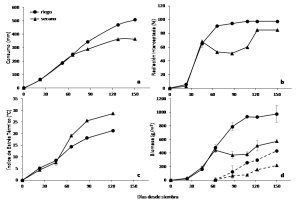
Figure 1. Responses associated with water and carbon economy in peanut cultivation growing under contrasting water conditions.
The depth of the irrigation laterals was 35 cm, significantly distant from the growth and harvest zone of the pods (0-15 cm) (Fig. 2a). The depth of the laterals coincides with the region of greater density and root architecture, which guarantees the efficient access of water and nutrients supplied by this technology. Meanwhile, the subsurface provision of water minimizes the evaporation of water from the soil, thereby increasing the availability of water to the crop and exacerbating the differences in growth between water environments (Fig. 2b).
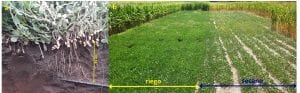
Figure 2. (a) Subsurface supply of irrigation to peanut crops. (b) Peanut crop growing in contrasting water conditions.
Conclusions
The SDI system increased the efficiency in the use of total biomass, water, and pods, resulting in a 95% increase in grain yield under irrigated conditions.
The significant contrast between the growth and harvest zones of peanut pods, along with the deepening of the irrigation laterals in the silty loamy soil, demonstrates the feasibility of using SDI technology in peanut fields.
Bibliographic References
HARO, R.J.; DARDANELLI, J.L.; COLLINO, D.J.; OTEGUI, M.E.; Water deficit and impaired pegging effects on peanut seed yield: link with water and photosynthetically active radiation use efficiencies. Field Crops Research, v.61, p. 343-352.
https://inta.gob.ar/documentos/informacion-meteorologica-mensual-de-la-eea-manfredi. Monthly meteorological information of the EEA Manfredi. National Institute of Agricultural Technology. Valid as of July 11, 2019.
JACKSON, R.J.; REGINATO, R.D.; IDSO, S.B. Wheat canopy temperature: a practical tool for evaluating water requirements. Water Resources Research, v.13, p.651–656, 1977.
LAMM, F.R.; MANGES, H.L.; STONE, L.R.; KHAN, A.H.; ROGERS, D.H. Water requirement of subsurface drip-irrigation corn in Northwest Kansas. American Society of Agricultural Engineers, v.38 (2), p. 441-448, 1995.
SEVERINA, I.; GIUBERGIA, J.O.; SALINAS, A.; MARTELLOTTO, E.; ARCE, A.; BOCCARDO, M.; ANDRIANI, J. Validation of two water balance methodologies in irrigated wheat cultivation under supplementary irrigation, in the central region of Córdoba. In Technical Dissemination Bulletin No. 11, editions of the National Institute of Agricultural Technology, 2012.

