
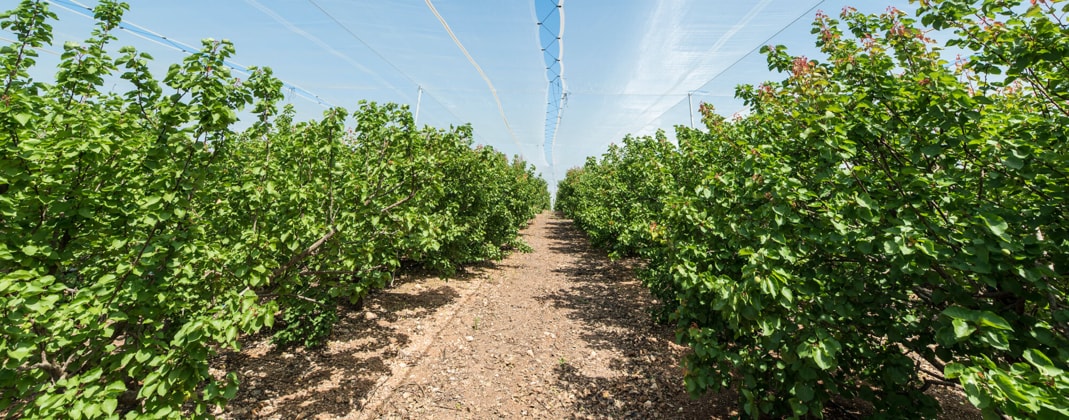
Irrigation plays a crucial role in determining fruit size and weight, as well as crop quality and yield. However, to ensure efficient water use, it is also important to follow the necessary drip irrigation installation and maintenance procedures, such as pruning and thinning.
Drip Irrigation Installation and Maintenance Procedures:
- Dripper selection: Select a dripper that matches the local site conditions to ensure optimal water delivery and high-quality yields.
- Drippers not in use: In young orchards using integral drippers, it is recommended to seal unused drippers. For online drippers, consider additional installation depending on the age of the tree.
- Cleaning and maintenance: Pruning trees and clearing weeds help achieve efficient irrigation.
- Thinning: Thinning determines the final crop’s quality and quantity. Key principles:
- Adjust the number of fruits on the tree according to the spacing between trees.
- Adapt thinning to changes in water supply: during drought, significant thinning is necessary.
- Ensure even distribution of fruit on the tree for optimal water use.
- Adjust thinning based on the desired fruit size (usually not less than 60 mm in diameter).
- Driplines: In mature orchards with high irrigation needs (in tropical and subtropical regions), plan for a second or even third pipe to be installed when the trees begin to bear fruit (from the fifth or sixth year onward).
- Dripline wall thickness: To maximize the durability of drip irrigation systems and protect driplines and drippers from early deterioration due to weather, chemicals, and other harmful factors, it is important to use high-quality polymer blends that maintain flexibility and durability over time. Additionally, pipe resistance to mechanical damage mainly depends on wall thickness: a thicker wall is more resilient than a thinner one. However, keep in mind that manufacturing thicker pipes requires more raw materials, which increases system costs.

Annual Irrigation Plan Sample
- Peach and nectarine
- 700m above sea level, temperate climate
- 660 trees/ha, 3x5m spacing
- Harvest at the end of July, expected yield: 50 ton/ha
|
Month |
Avg. Pan Evaporation (mm/day) |
Pan Evaporation Factor |
Avg. daily irrigation |
Monthly Quantity (m3/ha) | |
|---|---|---|---|---|---|
|
Liter/tree/day |
m3/ha/day |
||||
|
April |
3.0 |
0.5 |
22.7 |
15 |
450 |
|
May |
5.2 |
0.7 |
55.4 |
36.6 |
1100 |
|
June |
8.3 |
0.8 |
101 |
66.6 |
2000 |
|
July |
8.5 |
0.9 |
116 |
76.6 |
2300 |
|
August |
7.6 |
0.25 |
28.7 |
19.0 |
570 |
|
September |
7.2 |
0.20 |
22.7 |
15 |
450 |
|
October |
5.0 |
0.19 |
14.4 |
9.5 |
285 |
|
Season Total |
7155 |
||||
* The figures in this table are taken from the orchard’s database and are for reference only. Your irrigation plans should be based on meteorological data and the topographical conditions at your orchard site, using the following calculation method:
1 mm/day from pan = 10 m3/ha
Avg. pan evaporation X Pan evaporation factor X 10 = irrigation quantity (m3/ha/day) ?

Dripper Selection
When selecting a dripper, always consult your agronomist or project designer. The dripper should match the hydraulic specifications, water capacity, and plant requirements. For more information, please consult the Metzer experts.
Vered Dripper
VERED is a flat integral dripper with a unique pressure-compensating mechanism and a large inlet filter. It is the most popular dripper for orchards. Thanks to its high durability and excellent field performance, the VERED dripper is also the preferred choice for growers of vines, deciduous trees, and subtropical crops.
Click here to view the Vered Dripper product sheet

ADI Dripper
ADI, a cylindrical pressure-compensating dripper with a large inlet filter, is considered the best of its kind. With outstanding reliability and resistance to clogging, this dripper provides the best solution for orchards and row crops in challenging terrain. The ADI dripper is also ideal for irrigation with treated effluent and for subsurface drip irrigation systems.
Click here to view the Adi Dripper product sheet
Click here to read an article about the Subsurface Drip Irrigation method

Vardit Dripper
VARDIT is a flat integral dripper with a precise pressure compensation mechanism. It is the best choice for a modern, well-designed orchard with a reliable water source. With its sleek and relatively small design, the VARDIT is an economical dripper that offers a quick return on investment.
Click here to view the Vardit Dripper product sheet

Gali Dripper
GALI is an online PC/PCND dripper with a unique pressure compensation mechanism and a compact design. It is highly efficient and economical—a small dripper with excellent performance. The GALI dripper is the ideal choice for new plantings, young orchards, and greenhouse crops grown on soilless substrates.
Click here to view the Gali Dripper product sheet

Drip Irrigation Installation for Orchards
Orchards and plantations are the most demanding environments for drip irrigation pipes, where exposed driplines on the surface are susceptible to mechanical damage. Orchards can also attract rodents, birds, and other animals that may damage the driplines. Therefore, driplines in orchards and plantations typically have the thickest walls: 0.9-1.1mm.

An alternative to increasing wall thickness is to use sub-surface driplines which are protected from most of the hazards mentioned above.


